For Students

Keep research, deadlines, expectations, and team responsibilities connected.

Big research projects can feel like a wall of vague expectations. Boomerang Projects breaks that wall into steps you can actually work through — with the rubric next to your writing, the timeline planned backward from your deadline, and every source scored for credibility as you build your bibliography.

You keep the freedom to choose your question and shape your argument. The workspace keeps the structure that makes the work possible.

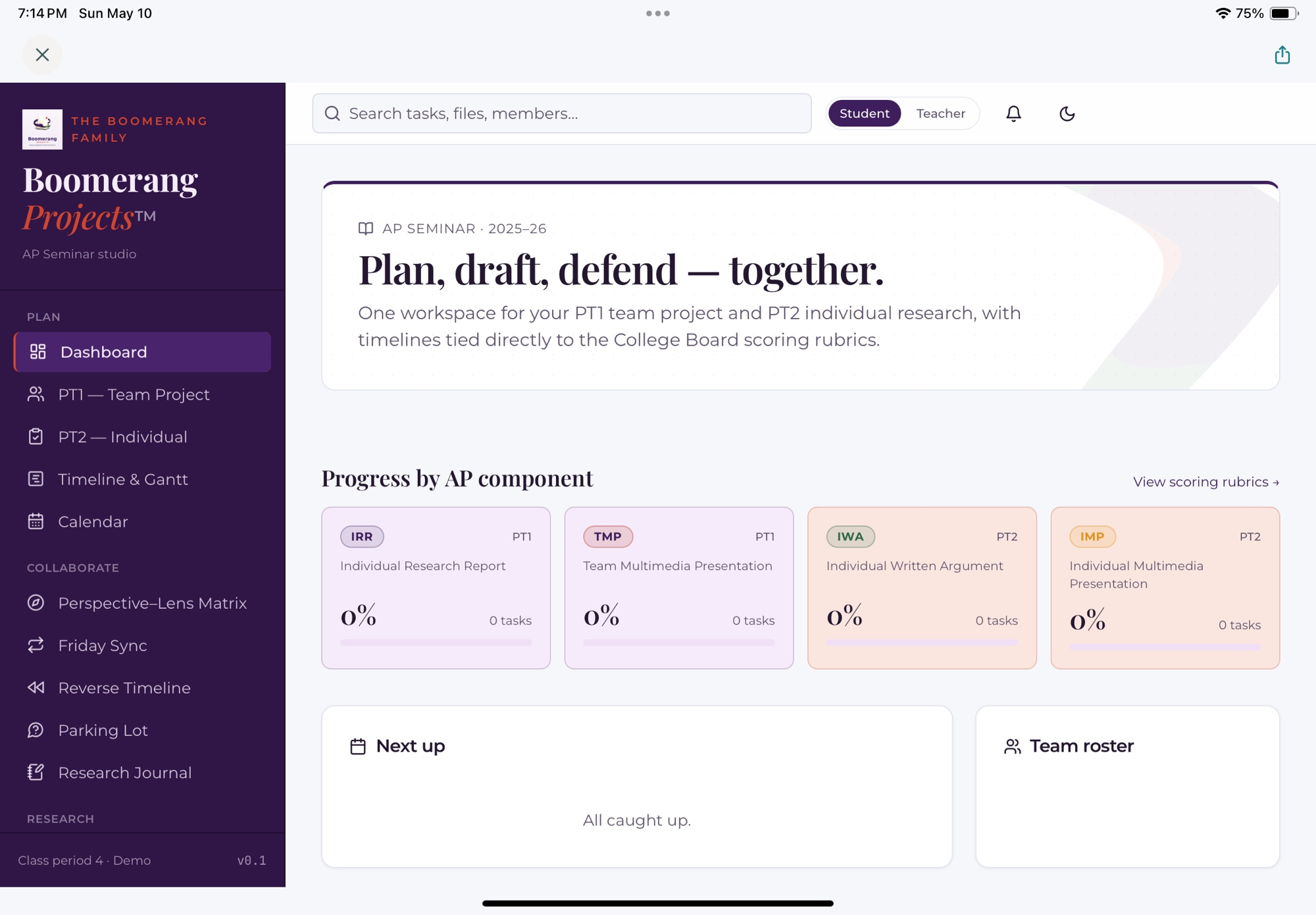
A student's view inside Boomerang Projects — their research dashboard with the reverse timeline, active studio, and annotated bibliography visible in one screen.

Not another to-do list. A workspace for thinking.

Boomerang Projects is designed for the kind of school work that unfolds over weeks or months — research reports, argument papers, senior capstones, science fair projects, IB® Extended Essays, AP Seminar performance tasks, portfolio pieces, and team presentations.

It gives your project a shape you can see: what you're working on, what's next, how it maps to the rubric, and how much time you actually have to finish it well.

Six features you'll use every week.

Every surface is designed to make a real research task lighter — without doing the thinking for you.

Reverse Timeline

Pick your final due date and the workspace builds every checkpoint backward — topic lock, perspectives map, bibliography, first draft, peer feedback, revision, final. Each milestone explains the why, so you're learning planning, not just meeting deadlines.
Annotated Bibliography with credibility built in

Every source is scored against the framework your teacher picked — SIFT, CRAAP, or RAVEN — with evidence fields under each score. Weak sources get flagged; strong ones get a green verdict. You end the project with a bibliography that could stand up to a review.

Rubric-inside-the-work feedback

The rubric doesn't wait on the last page. It sits next to your draft, your bibliography, and your presentation planner. When your teacher gives feedback, it's attached to the rubric row — so you know exactly what to fix and why.

Research Journal

A private, low-friction place to think out loud — questions, false starts, sources you almost used, a paragraph you might come back to. Nothing here is graded. All of it belongs to you.

Team Board

Group projects live on coordination. A shared board makes every teammate's work visible, tagged to a rubric row and an owner. Contribution Receipts make sure your work is counted — including the parts that usually go invisible.

Credibility Lab

A practice surface for source evaluation. Score a real source against the framework your teacher chose. Then switch frameworks to see how the same source reads under different criteria. Weak scores flag automatically.

What it feels like to work inside it.

You open Boomerang Projects and see one screen. Your active studio is in the sidebar. This week's kanban — to explore, reading, drafting, done — is front and center. A running conference thread with your teacher is right where you can see it. Recent research-journal entries are on the right.

You don't dig through folders for the rubric. You don't reformat citations at 2 a.m. You don't wonder whether your teammate did their part. You spend your time on the actual work — reading, thinking, writing, revising — and less on managing the mess around it.

Your work belongs to you.

Boomerang Projects is designed as a privacy-first workspace. Your research journal, your drafts, your notes, and your bibliography are yours. Your teacher sees the parts of your project that they need to teach you — not everything you type, not every tab you open, not every click you make.

Signals in the workspace are meant to lead to a conversation, not an automatic consequence. If something is off, the next step is a real interaction with a real teacher.

See it for yourself

Take a five-minute tour of the student view.

No sign-up. No form. Click in, poke around, and see what the workspace actually looks like from a student's seat.

Take the Student Demo Tour

Boomerang Projects student view — a research desk with this week's kanban, the annotated bibliography, and the reverse timeline in one workspace.

Think your class could use this? Show your teacher.

Your teachers are the people who decide what tools show up in class. If Boomerang Projects looks useful, the fastest way to make it real is to send them a short note.

Copy the text below and paste it into an email or a message to your teacher. That's it — no forms, no accounts, no email app opening on its own.

You don't have to use it word-for-word — change anything so it sounds like you.

Student FAQ.

Is Boomerang Projects only for AP or IB students?

No. It works for any long-form research or project-based work — research reports, argument papers, science fair projects, capstones, and team presentations. AP Seminar and IB Extended Essay are two of the studios, not the whole product.

Do I have to install anything?

No. It runs in a browser. If your teacher enables it for the class, you sign in and start working. The demo tour doesn't require sign-in at all.

Does my teacher see everything I type?

No. Your research journal is yours. Your teacher sees the parts of your project designed to be shared — your bibliography, your drafts submitted for feedback, your milestone status, your team-board contributions. The rest belongs to you.

Does it write my paper for me?

No — and it's not supposed to. Boomerang Projects supports the process. The thinking, the writing, and the argument stay with you.

How do I actually get access?

Your teacher or school enables it for your class. If your teacher doesn't know about it yet, the fastest way is to share the site with them — there's a ready-to-send email above.