For School Leaders

Support strong project implementation, teacher judgment, and privacy-conscious adoption.

Schools ask students to research difficult questions, collaborate responsibly, manage long deadlines, evaluate evidence, produce substantial writing, and present their conclusions. Boomerang Projects gives that work a coherent instructional structure while preserving teacher judgment and student ownership.

It can begin with one teacher and one classroom. No schoolwide migration is required.

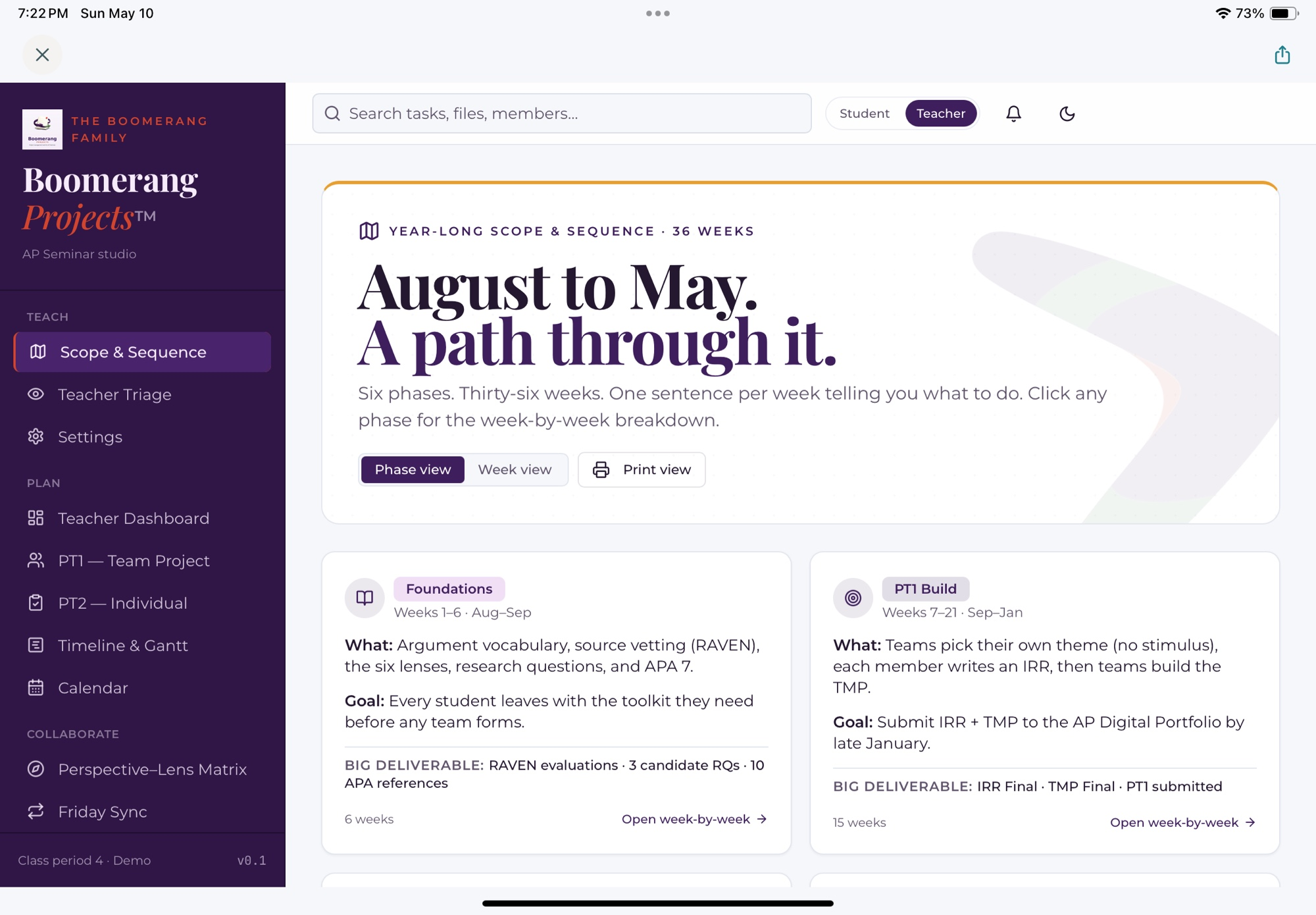
An administrator's view inside Boomerang Projects — cohort-level project progress, milestone patterns, and privacy-first data flow.

Schools invest in the outcome. Teachers carry the process.

The final paper, presentation, exhibition, or portfolio is easy to see. The months of work underneath it are not.

Teachers are often left to manage extended projects through a patchwork of documents, spreadsheets, email threads, learning-management-system posts, shared drives, and classroom conversations. Students may receive excellent instruction and still struggle to understand the sequence of the work.

School leaders then face difficult questions:

  • Are students receiving a coherent experience across classrooms?
  • Are project expectations clear before the final deadline?
  • Are team contributions visible and equitable?
  • Can teachers identify students who need support without monitoring them excessively?
  • Is student information being handled responsibly?
  • Can a successful project model be repeated or scaled?

Boomerang Projects was designed around those questions.

A shared structure without a scripted classroom.

Instructional coherence should not require every teacher to teach the same lesson in the same way. Boomerang Projects gives schools a common project structure while allowing teachers to preserve their curriculum, professional judgment, and disciplinary approach.

Teachers can work from shared studios, rubrics, milestones, and research practices. They can also adjust the language, sequence, pacing, resources, and expectations to fit their students.

The result is greater consistency in the student experience without turning teaching into compliance.

What Boomerang Projects adds.

Six changes to day-to-day project work that school leaders can actually see.

Clearer project implementation

Studios give complex projects an understandable beginning, middle, and end. Instead of asking every teacher to construct a digital workflow from scratch, Boomerang Projects provides adaptable structures for research reports, argument projects, team presentations, extended research, science fairs, portfolios, capstones, and general inquiry.

Stronger student ownership

Students see their project stage, milestones, rubric expectations, research notes, team responsibilities, and feedback in one workspace. The system does not complete the thinking for them — it makes the work understandable enough for them to take responsibility for it.

Useful instructional visibility

Teachers can see progress and patterns without opening a separate document for every student. The purpose is not constant monitoring; it is earlier recognition — a stalled bibliography, a missed milestone, a project that needs a conference, a classwide skill that deserves additional instruction.

More accountable collaboration

Team boards connect tasks to owners, project expectations, peer-review stages, and completed work. Contribution Receipts help preserve evidence of participation, so teachers can respond to collaboration with more than impressions.

Better use of teacher time

Teachers should spend their time teaching research, discussing ideas, conferencing with students, and responding to meaningful work — not repeatedly rebuilding timelines, relocating rubrics, or asking students to explain where their files are.

A more coherent student experience

When project expectations, timelines, source practices, feedback, and reflection live in the same environment, students spend less effort navigating the system and more effort doing the work.

Between assignment and submission.

A traditional learning-management system is essential for distributing materials, posting assignments, recording grades, and collecting final work. It was not designed to manage the evolving process of a four-week, three-month, or yearlong investigation.

Boomerang Projects does not compete with the school's LMS. It addresses a different part of the instructional experience:

  • The LMS records that the project was assigned. Collects the final submission. Records the grade.
  • Boomerang Projects helps students complete the project. Preserves the path that led to the submission.

This allows schools to strengthen extended project work without replacing the systems they already depend on.

Visibility without surveillance.

Schools need enough information to support students and teachers. They do not need another system that treats every student action as a behavioral metric. Boomerang Projects is designed around purposeful visibility.

Students see their own work and responsibilities.
Teams see the work they share.
Teachers see the patterns needed for instruction and support.

The platform is not intended to rank students, automate disciplinary decisions, or replace a teacher's understanding of the classroom. When a pattern appears, the next step should be a human conversation.

One platform, multiple academic programs.

Boomerang Projects is designed around reusable studios rather than a single course. A school may use it to support:

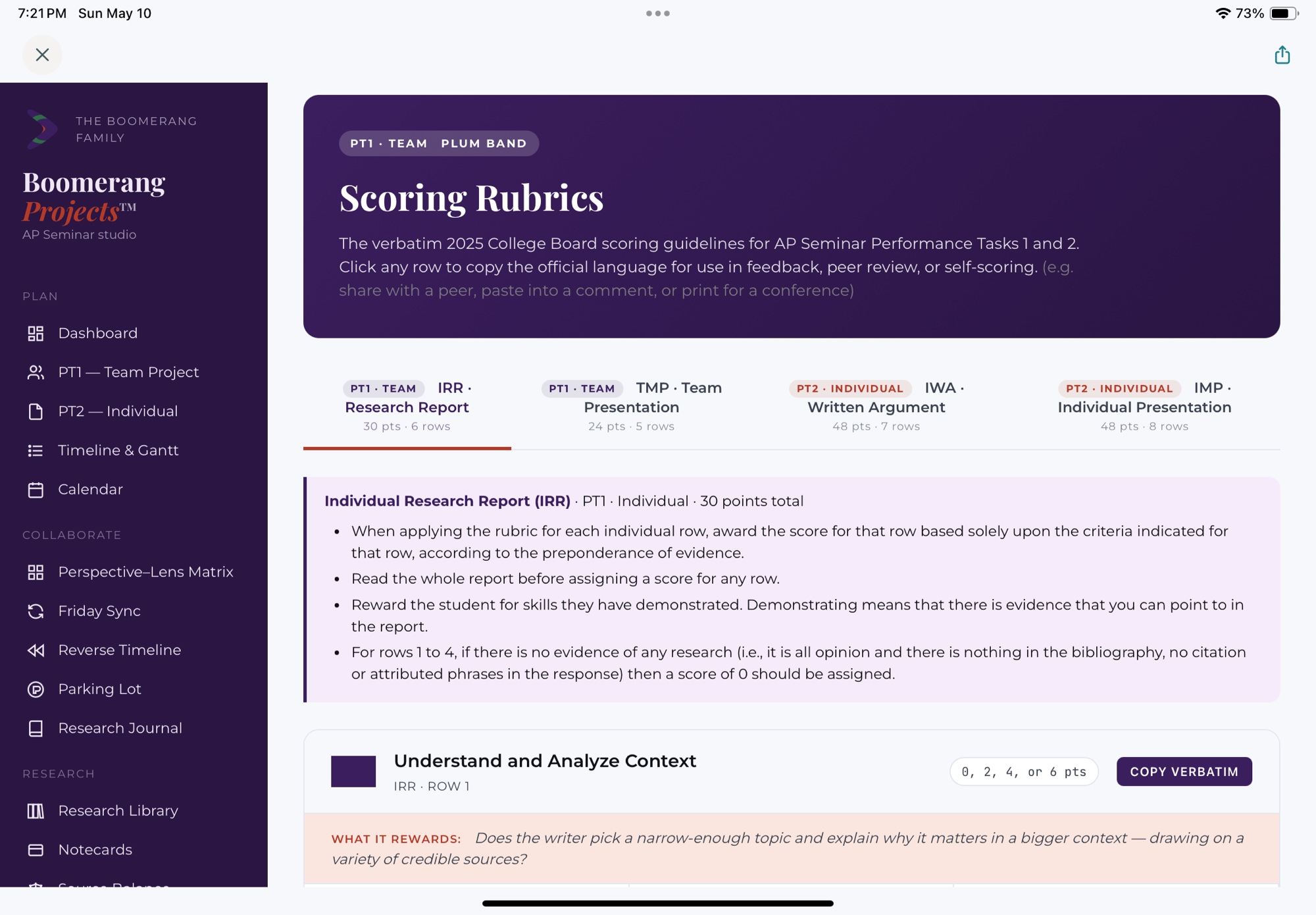
  • AP Seminar and AP Research coursework
  • Senior capstones and thesis projects
  • Interdisciplinary research units
  • Science fairs and lab-based inquiry
  • Team presentations and communication-heavy courses
  • Research reports and independent investigations
  • Portfolio-based learning
  • IB® Extended Essay coursework
  • Project-based English, history, science, or social-science courses

Each program may retain its own rubric, sequence, terminology, and requirements while benefiting from a common project-management foundation.

Boomerang Projects is independent and is not affiliated with, sponsored by, or endorsed by the College Board or the International Baccalaureate Organization.

An overview of Boomerang Projects across multiple studios — AP Seminar, senior capstone, science fair, and portfolio projects — inside a single school.

Privacy is an implementation requirement.

Student trust should not be exchanged for administrative convenience. Boomerang Projects is being built as a privacy-first educational workspace, with data minimization and limited student identification at the center of the design.

Schools should be able to understand:

  • What information is collected
  • Why each piece of information is necessary
  • Who can access it
  • Where it is stored
  • How long it is retained
  • How it can be corrected or deleted
  • Which third-party services, if any, are involved

Detailed information is available through the Privacy & FERPA documentation and the school-review process.

Start with one teacher. Scale only where it adds value.

A school should not have to make a districtwide commitment before learning whether a product is useful. Boomerang Projects can begin as a focused pilot.

  1. Begin with a real instructional need. Choose one AP Seminar section, senior capstone, science-fair cohort, or extended research unit.
  2. Preserve the teacher's curriculum. The pilot should support the course already being taught rather than requiring the teacher to rebuild it around the software.
  3. Set clear evaluation questions. Did students understand what to do next? Did teachers spend less time managing files and reminders? Did collaboration become more visible? Did rubric use improve before final grading? Was the amount of student information collected proportionate and understandable? Would teachers choose to use it again?
  4. Scale only where it adds value. A successful pilot can expand to additional classes, departments, project types, or grade levels. An unsuccessful pilot should produce honest information about what needs to change.

Early access is intended to make that evaluation possible.

Built from inside the classroom.

Boomerang Projects was founded by a working educator with more than twenty years of classroom experience. That perspective shapes the product.

Teachers do not need software that assumes they are failing to manage their classrooms. They need tools that respect the complexity of the work, reduce unnecessary friction, and give them more time for the decisions only a teacher can make.

Students do not need a system that completes the project for them. They need a structure that helps them understand the project well enough to complete it themselves.

That is the standard Boomerang Projects is being built to meet.

Next step

Ready to explore a pilot?

Early-access partners get direct access to the founder while the product is being built, and their feedback shapes what v1 ships with.

Explore the Product Discuss an Early-Access Pilot

Frequently asked questions.

Does Boomerang Projects replace our LMS or student-information system?

No. It is a specialized workspace for managing extended academic projects. Schools continue using their existing systems for enrollment, grades, communication, routine assignments, and final submissions.

Does a school have to adopt it across every classroom?

No. Implementation can begin with one teacher, one program, or one project type.

Is it an AP or IB product?

No. Boomerang Projects is an independent product. It may support coursework associated with those programs, but it is not affiliated with, sponsored by, approved by, or endorsed by the College Board or the International Baccalaureate Organization.

Does it provide a complete curriculum?

It provides studios with project structures, targeted lessons, resources, timelines, rubric templates, research tools, and student guidance. It does not replace a school's curriculum or dictate what teachers must teach.

How should a school evaluate it?

The best evaluation is a bounded classroom pilot with defined instructional, usability, privacy, and implementation criteria. Early-access partners also have a direct channel for providing product feedback.

Does the platform use automated monitoring to make decisions about students?

The product is designed to surface information for teachers, not to make consequential decisions in their place. Signals should lead to human review and conversation.