Honoring student-led inquiry at scale
How do we give students room to explore, question, and imagine — while keeping a class of forty moving forward together?
Why Boomerang Projects
Boomerang Projects was built on a simple idea: the freedom that makes extended research projects worthwhile is worth protecting, and the structure that protects it should support student thinking — not interrupt it.
As a Student Research Project Management System, it makes the path from first question to final presentation visible to students and teachers.

Students choose questions that matter to them. They evaluate evidence from many perspectives. They build arguments. They present findings to an audience. Whether the project is a Research Report, a Team Presentation, a Senior Capstone, a Science Fair board, or an IB® Extended Essay, the underlying promise is the same: that thinking should lead somewhere — toward solutions an engineer, a community, or a policymaker could actually implement.
That promise is also why these projects are hard to manage. A classroom built on student freedom needs more support around it, not less.
Across teacher communities and in everyday teacher-to-teacher conversation, the same questions kept coming up about long-form research projects.
How do we give students room to explore, question, and imagine — while keeping a class of forty moving forward together?
Some weeks the energy is high. Some weeks it isn't. Teachers wanted ways to recognize a stalled project early enough to hold a useful conversation.
Rubric language, source-credibility scoring, citation formatting, sample structures — all of it exists, but it lives across the internet. Teachers wanted those resources in one place, available the moment a student needs them.
Student time on real research. Teacher time on real feedback. Less time spent reformatting documents, hunting for templates, and re-explaining the rubric.
Visible process in the age of AI
Boomerang Projects makes the developing work legible. A teacher can see when a question changed, why a source entered the project, how a line of reasoning developed, what teachers and classmates returned, and what the student revised. The work moves outward in small steps and comes back through feedback, like a boomerang returning more than once across the life of the project.
This record gives students repeated opportunities to explain and own their choices. It also gives teachers richer evidence of authorship before the final paper arrives, reducing the need to rely on an AI detector after the work is complete.
Many project management tools are built around tasks. Many learning platforms are built around grades. Boomerang Projects is built around thinking — the kind of thinking extended research projects are supposed to produce.
The student dashboard exists to make the shape of the project knowable. The Reverse Timeline exists to turn a far-off deadline into next week's work. The annotated bibliography exists to make source literacy a habit. The team board exists to make collaboration visible — so a teacher can give credit where it's earned and support where it's needed. The teacher view exists to surface whole-class patterns, not to micromanage individual students.
None of it is built to replace teacher judgment. All of it is built to support it.
Inside the app
Each screen below is from the early-access build of Boomerang Projects. Some live in the student view. Others only appear when a teacher toggles in.
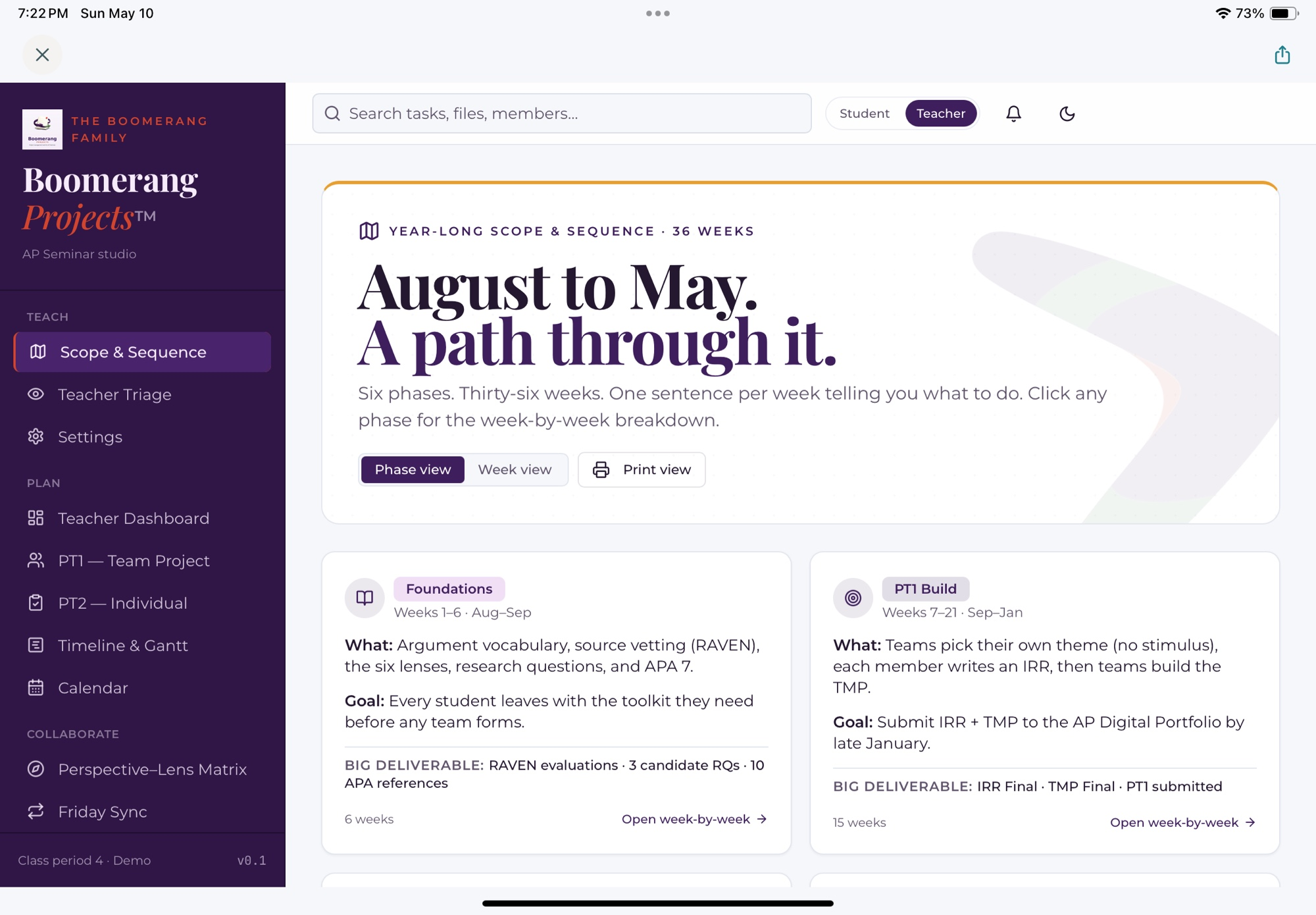
Teacher view · Scope and sequence
Boomerang Projects is built around eight studios. Each is a curated workspace tuned to one project type — loaded with the right rubrics, the right resources, and the right collaboration tools. Teachers can mix studios across a single class.
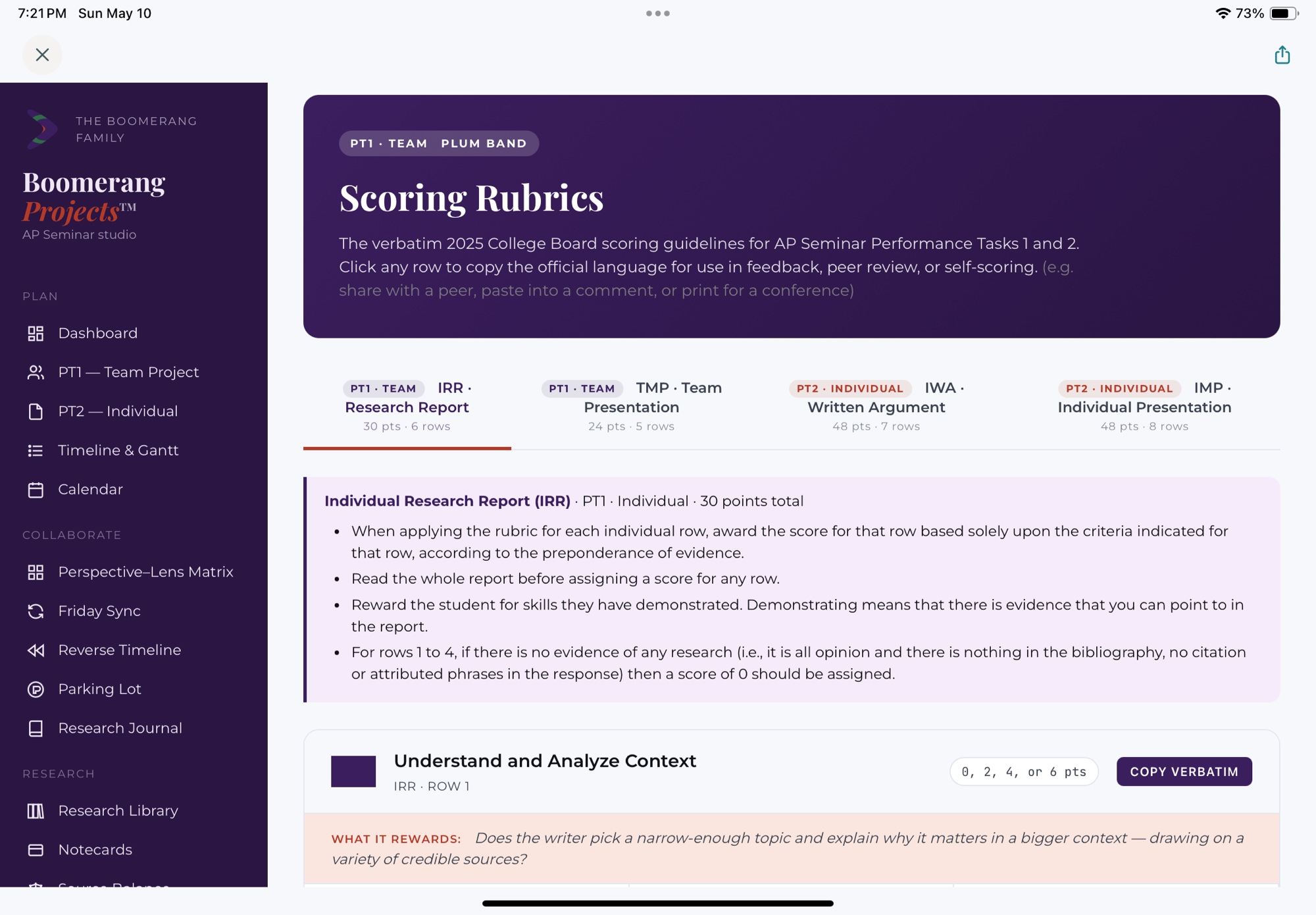
Teacher view · Rubric builder
Build rubrics in plain language — rows, levels, descriptors. Six starter templates get you to a working rubric in ten minutes. The rows then show up next to the draft, next to the bibliography, and inside self-assessment.
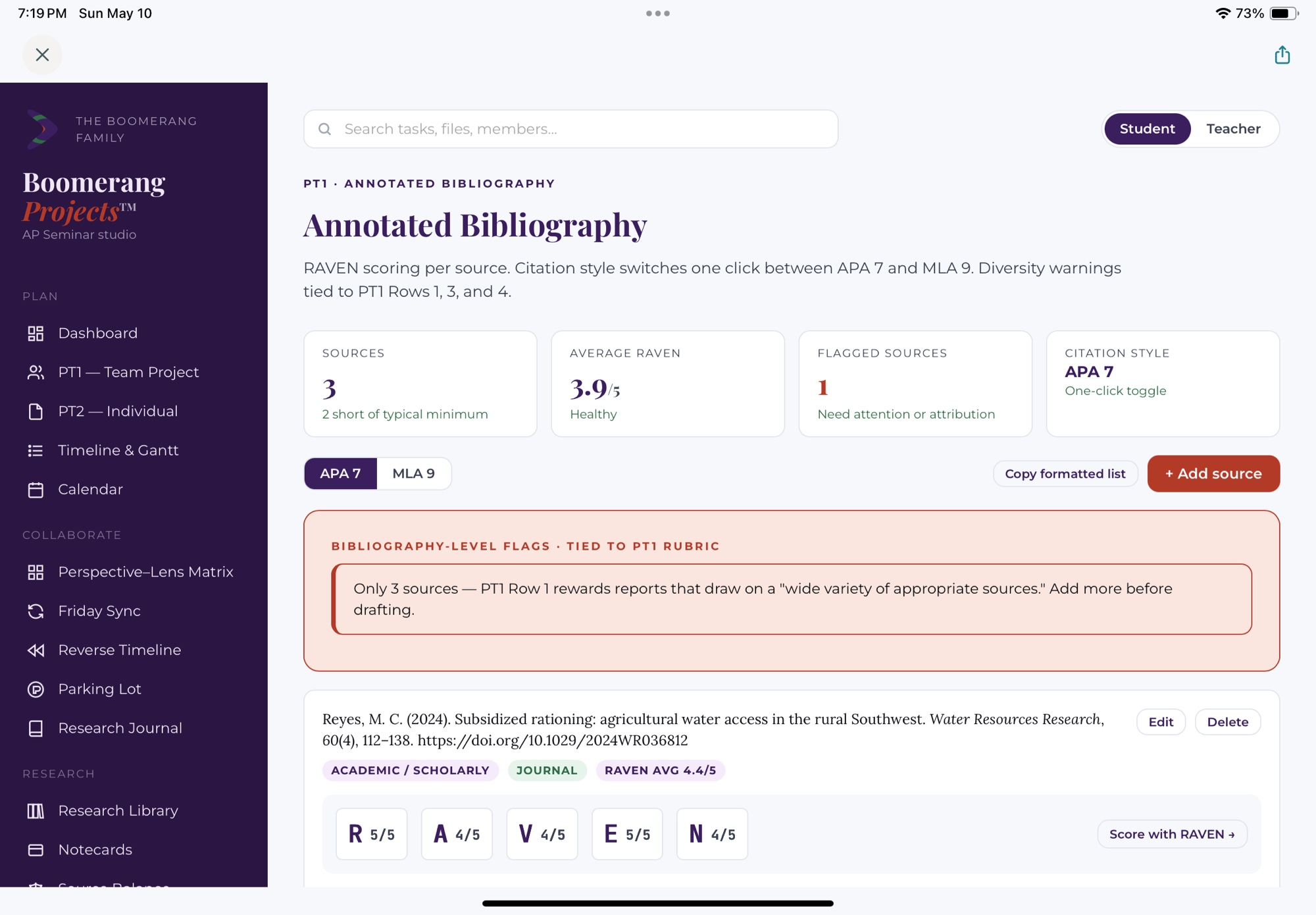
Student view · Source literacy
Source quality becomes a habit, not a hunch. Teachers pick the method that fits the classroom — SIFT, CRAAP, or RAVEN — with evidence fields next to each score and bibliography-level flags tied directly to your rubric.
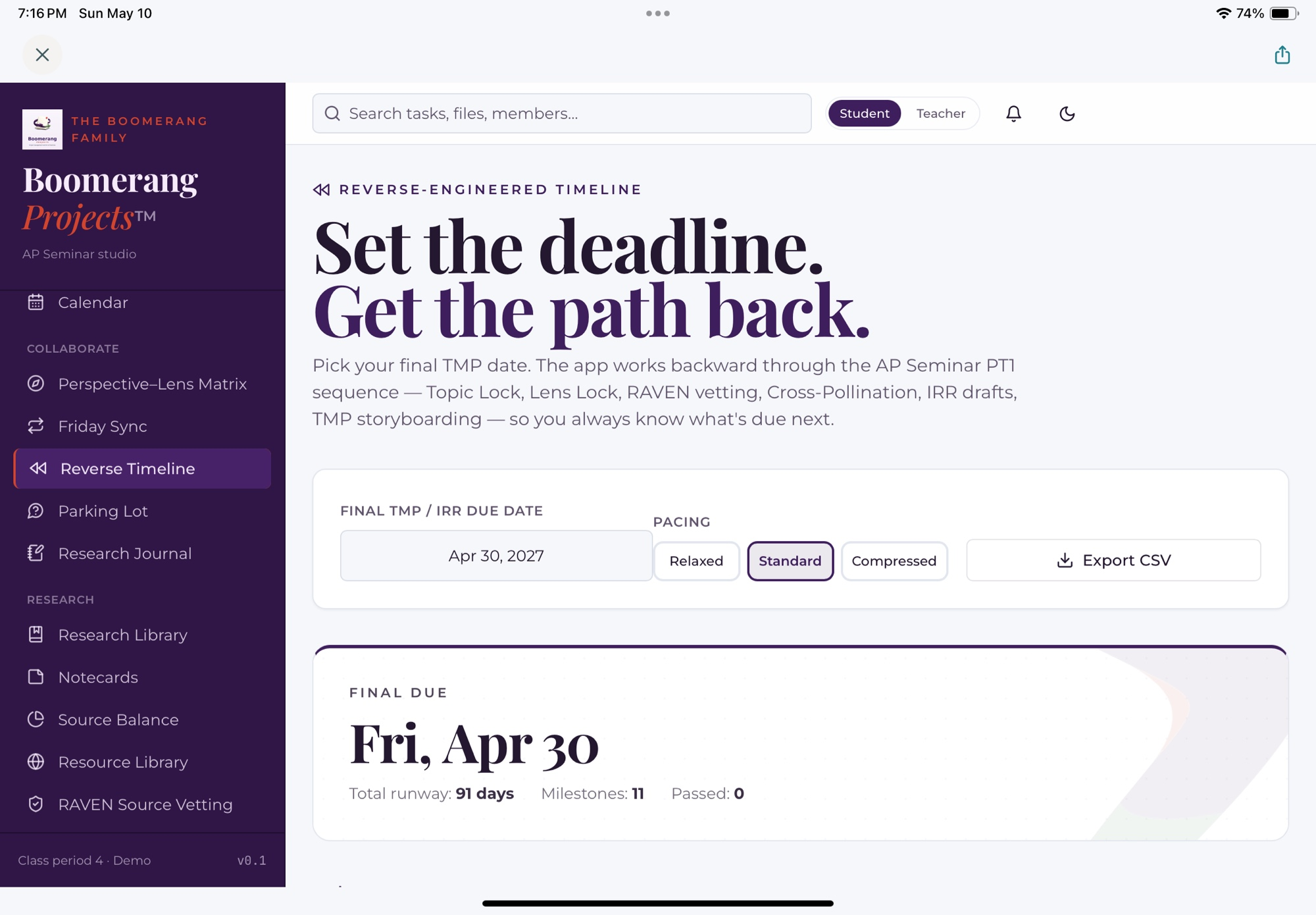
Student view · Project pacing
Pick the final due date and the workspace builds the checkpoints backward — Topic Lock, Perspectives Map, Bibliography, Draft 1, Peer Feedback, Final. Three pacing modes match the school calendar; export to CSV for the gradebook.
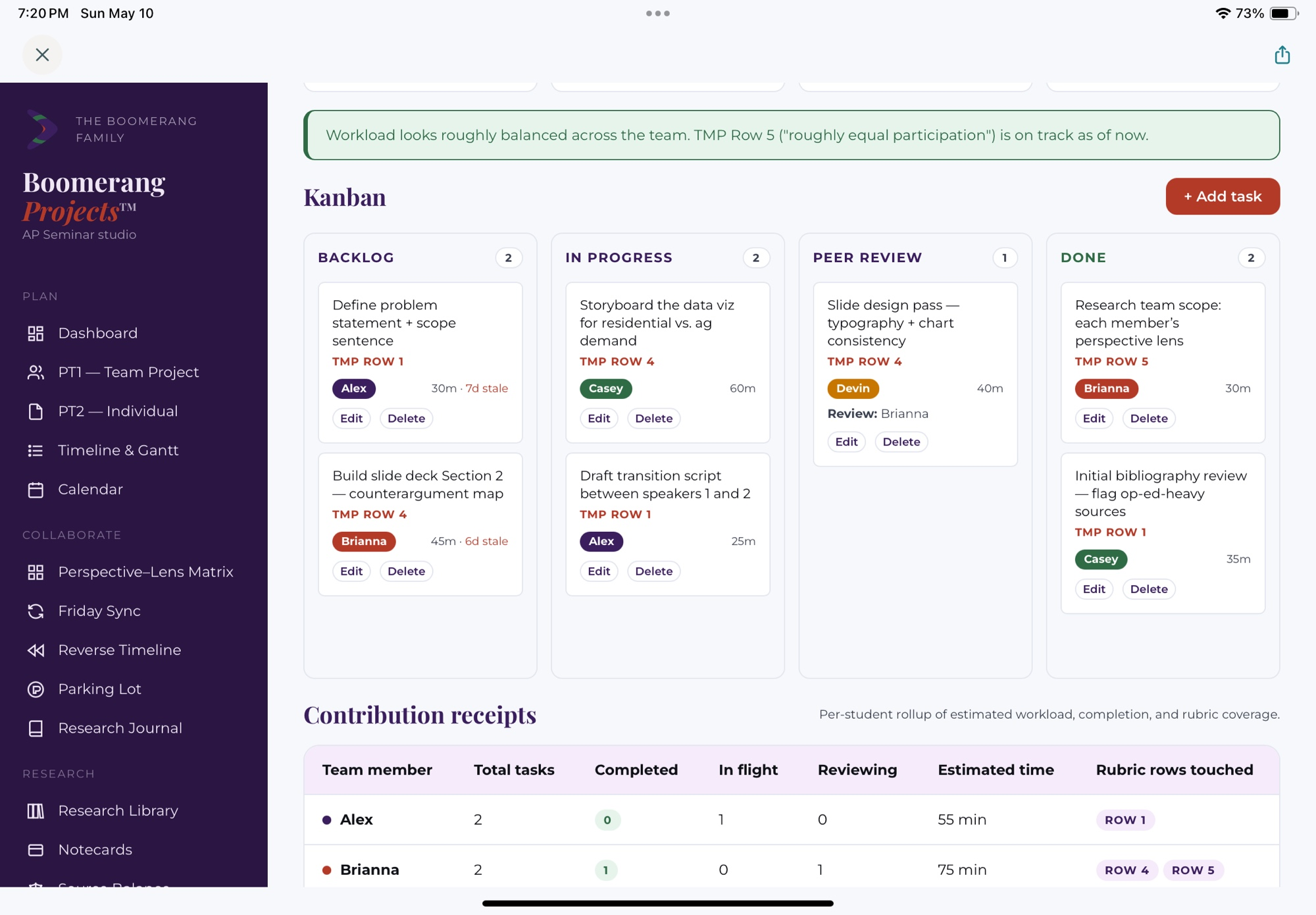
Student view · Group projects
Group projects live on coordination. A shared board keeps every teammate's work visible. Each card carries a rubric row, an owner, and an estimate. Contribution Receipts roll up per teammate, so participation evidence is built in.
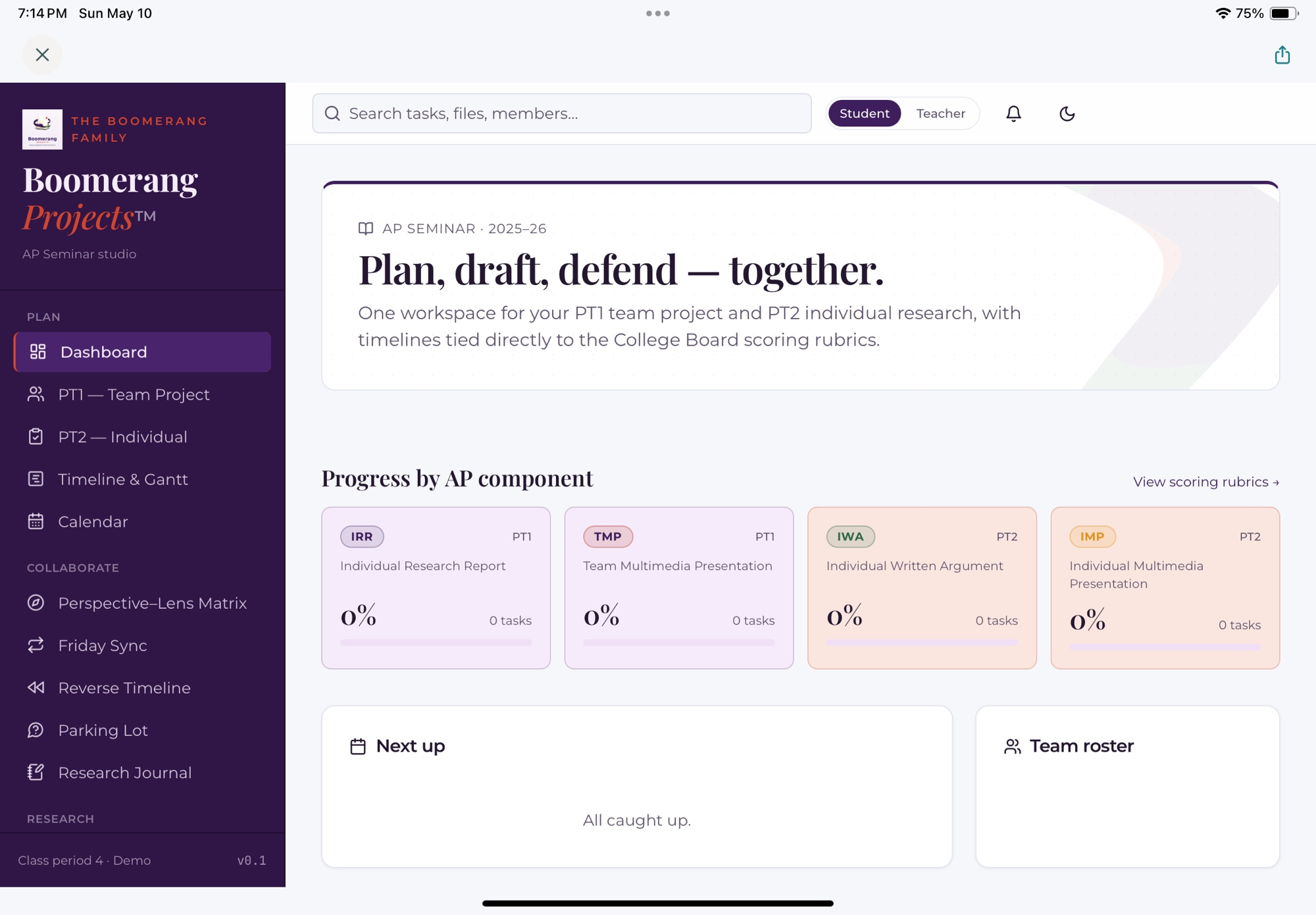
Student view · Daily home
One screen with the active studio in the sidebar, this week's kanban front and center, a running conference thread with the teacher, and recent research-journal entries on the right. Students see exactly what they're working on, what's next, and what their teacher just said.
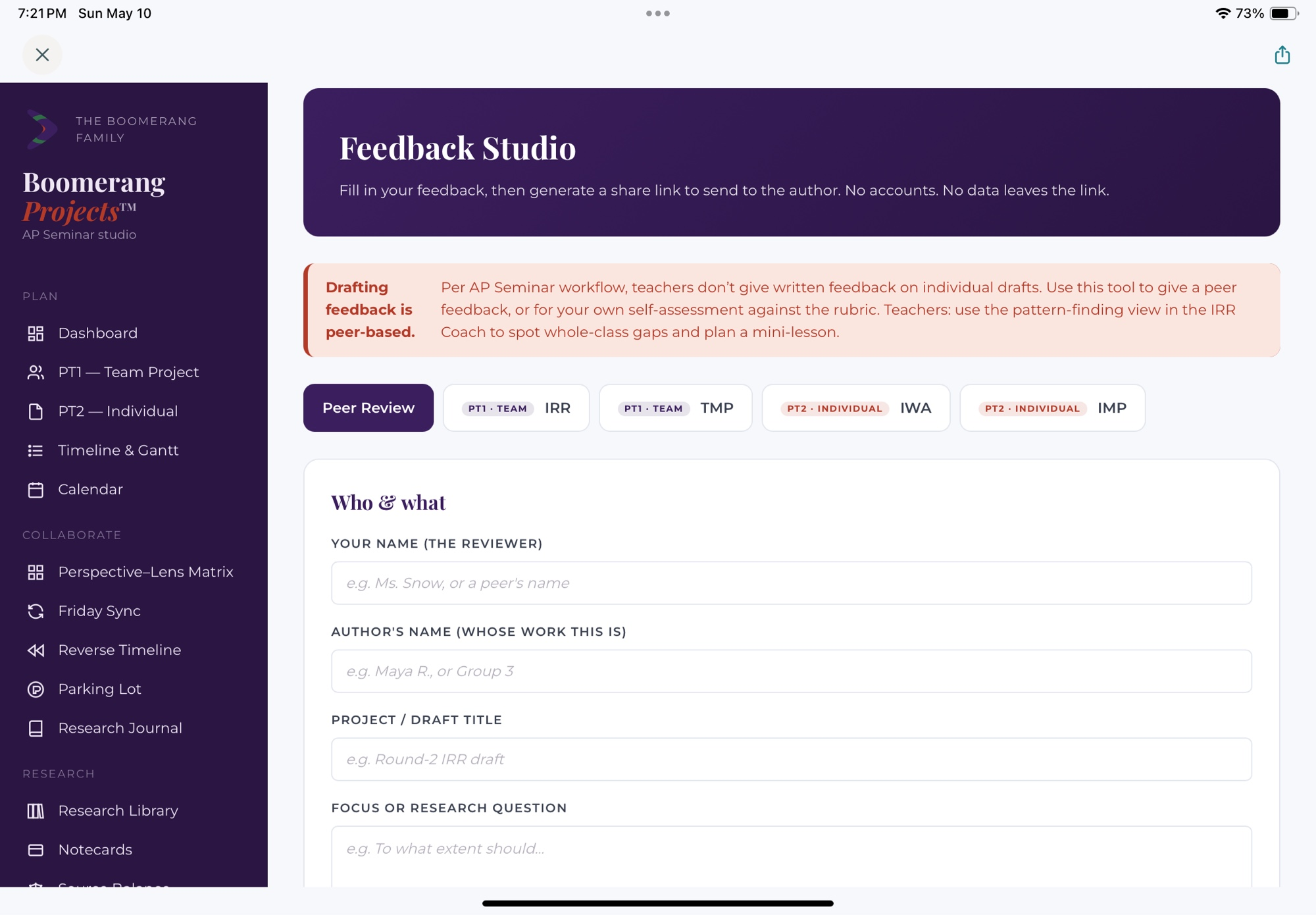
Student view · Peer review
Students respond to one another with shared rubric language. Teachers add conferences and targeted feedback where their judgment matters most. The writer's next revision stays linked to the response that prompted it.
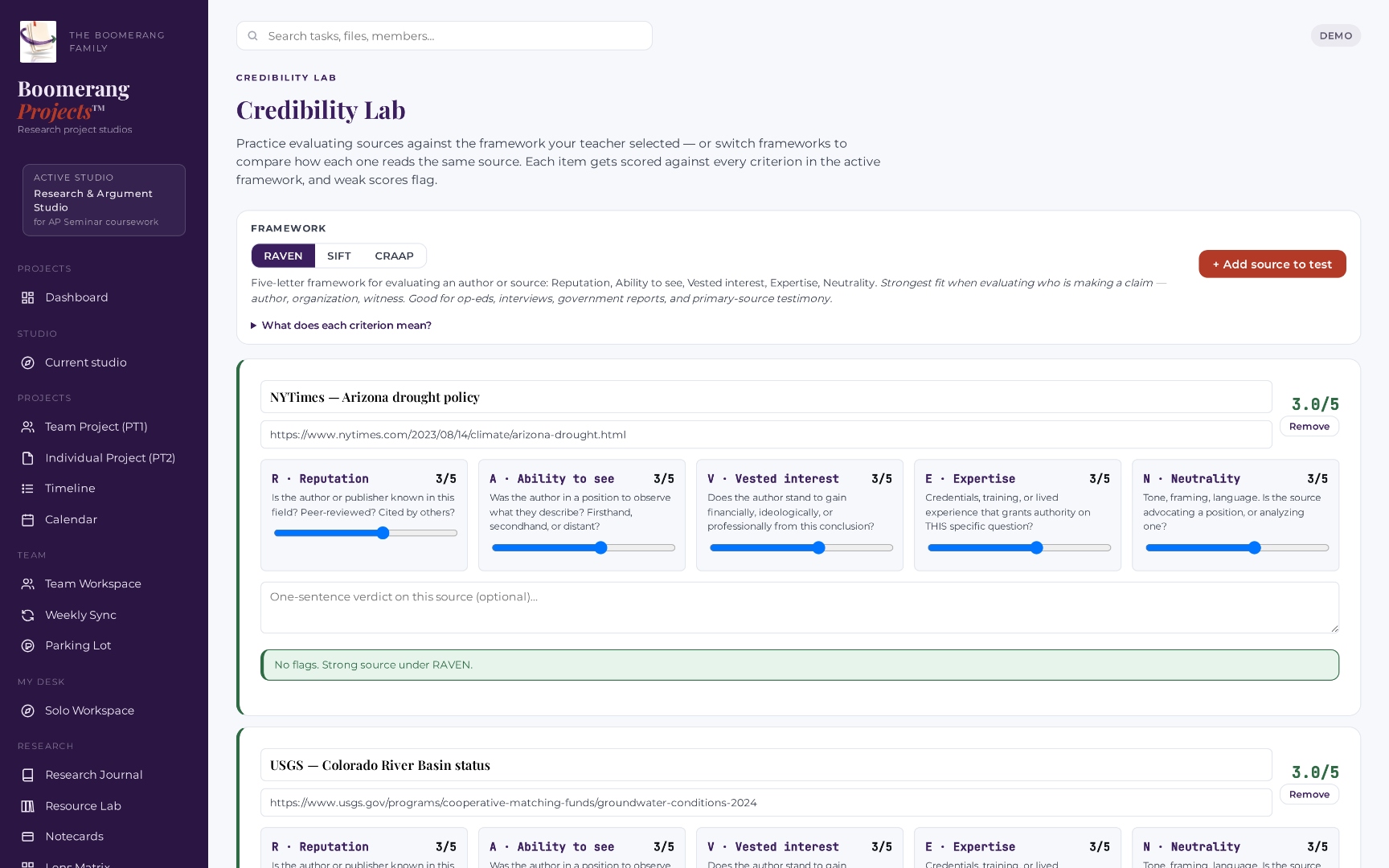
Student view · Source-evaluation practice
The Credibility Lab is the practice surface for source evaluation. Students score a real source against the framework the teacher selected, then switch frameworks to see how the same source reads under different criteria. Weak scores flag automatically.
Good research is honest about limitations, open about implications, and curious about possibilities. Boomerang Projects is built the same way.
The v1 early-access cohort is small on purpose. Early-access partners get free access throughout the early-access period and a direct line to the founder. The feedback we gather here is the rubric the next version is built against.
Our pilot is underway. We'll welcome another limited group of teachers in spring 2027. Join the waitlist, and we'll contact you as additional spots open.
Join the Pilot Waitlist"I built Boomerang Projects because the tools we put in classrooms should reflect the best of teaching — trust, judgment, and care. The freedom that makes extended research projects worth doing is worth protecting, and the structure that protects it is worth building well."
— Drew Snow, Founder & CEO, Boomerang Classroom